A wedding photography questionnaire should collect the decisions the photographer needs to plan coverage: the confirmed timeline, locations, key people, family groupings, visual priorities, access restrictions and delivery expectations. Send it after booking, then review the answers before the final planning call.
The template below contains 45 questions. Do not make every question required. Remove anything already covered by the contract or booking record, and use follow-up questions only when an earlier answer makes them relevant.
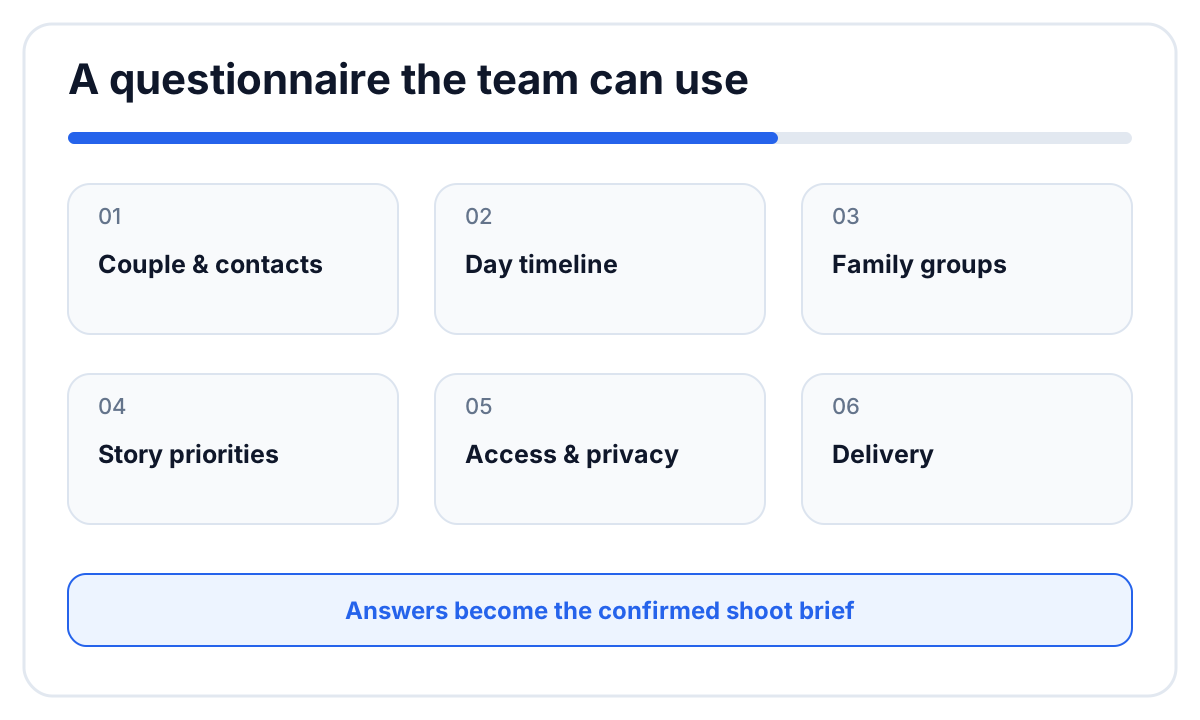 Group questions by the decision they support so the couple and production team can scan the answers.
Couple and primary contacts
- What names should we use for each partner?
- What are your preferred pronouns?
- What is the best email for final planning and delivery?
- What is the best phone number for the wedding day?
- Who can answer logistical questions if you are unavailable?
- Is there a planner or coordinator? Please include their name and contact details.
Keep contact questions separate from creative questions. The day-of contact should be someone who can solve access or timing problems without pulling the couple away from the event.
Wedding-day timeline
- What is the wedding date?
- When should photography coverage begin and end?
- Where will each partner get ready?
- What time is the ceremony scheduled to begin?
- What time does the reception begin?
- What time are the main reception events: entrances, speeches, first dance, parent dances and cake cutting?
- Is there a first look or another private moment before the ceremony?
- When and where can portraits happen?
- Is there a planned exit or late-night event?
- Which parts of the timeline are still tentative?
Use a timeline field rather than one long paragraph when your questionnaire supports it. A sequence of time-and-event rows is easier to compare with the studio calendar and the videographer’s plan.
Locations, access and travel
- What are the full addresses for getting ready, the ceremony and the reception?
- Are there parking, loading or security instructions?
- Does any venue restrict photography, flash, tripods or movement?
- Who can grant access to locked rooms or private areas?
- How much travel time should we allow between locations?
- Is transportation provided for the photo team?
- What is the indoor backup plan for portraits?
Ask for links to venue or planner documents when that prevents the client from retyping information.
Family and group photographs
- Which immediate family members should be included in formal photographs?
- Please list each requested group with names, not only relationships.
- Are there separated, divorced or estranged family members we should not place together?
- Are there mobility, hearing or health considerations that affect where or when a group can be photographed?
- Is there a family member or attendant who can help gather people?
- Which group photograph is most important if the schedule runs late?
- Are there important guests who may leave early?
A useful group list is executable. “Bride’s family” still leaves the photographer to decide who belongs in the frame. A list such as “Ava + Mira + Daniel + Ruth” can be checked off.
Story and visual priorities
- Which three moments matter most to you?
- Are there people, traditions or details with special meaning?
- Are there surprise events the photography team should anticipate?
- Are there photographs you definitely want?
- Are there photographs or poses you do not want?
- How would you describe the balance you prefer between candid moments and directed portraits?
- Are there heirlooms, memorial details or cultural elements we should understand before the day?
- May we coordinate with the videography team on shared portrait time and positioning?
Avoid asking the couple to reproduce a generic shot list. The photographer already knows to capture the ceremony and rings. The questionnaire should reveal what is specific to this wedding.
Privacy and communication
- May the studio share selected images on its website or social channels?
- Are any guests or children not to be photographed or published?
- Is the venue or event address private?
- Who may receive the final gallery link?
- Should any gallery chapter be visible only to the couple?
Treat privacy answers as operational restrictions, not casual preferences buried in notes. Put them where every assigned photographer can see them before the shoot.
Delivery expectations
- Who should receive the delivery email?
- Will the final delivery include photographs only, or photographs and films together?
The contract should define turnaround, usage rights and the included deliverables. The questionnaire can confirm recipients and presentation without renegotiating the package.
When to send the questionnaire
Send a short intake after booking only if the information is needed immediately. Send the detailed wedding questionnaire when the couple can answer accurately—often several weeks before the event—and set a deadline before the final planning call.
A practical sequence is:
- booking creates the project;
- the studio sends the questionnaire;
- the couple completes it before a clear due date;
- the producer reviews the answers and flags gaps;
- the planning call resolves open decisions;
- the final timeline and restrictions are placed in the project brief.
Do not send repeated copies when one answer changes. Keep the response attached to the project and record the confirmed decision in the brief.
How to design the form
Use field types deliberately:
| Information | Best field type |
|---|---|
| name, phone or short detail | short answer |
| story or sensitive context | long answer |
| one choice from a known list | single select |
| several applicable moments | multi-select |
| wedding-day schedule | timeline |
| permission or restriction | yes/no with a follow-up |
| planner document or venue page | link |
Make required fields visible, group the form into sections and test it on a phone. A couple may complete the form between appointments rather than at a desk.
How FlowShot questionnaires work
FlowShot lets a studio build reusable questionnaire templates with short and long answers, single and multiple selections, yes/no questions, links, section dividers and a dedicated day-timeline field. Follow-up questions can appear based on an earlier answer. The studio can apply its logo, colors, cover, welcome text and other presentation settings.
Each sent questionnaire becomes a project-specific instance. The client opens a standalone link, completes it without entering the studio workspace and can keep a draft in that browser until submitting. The studio sees the response with the project and receives a response notification. To follow up on an unanswered questionnaire, use Send again on the project’s questionnaire card, and keep the due date in the production workflow. With the CRM, on Solo and up, the questionnaire can also go out automatically a set number of days before the event.
The questionnaire is one part of the wider photography workflow. It should feed planning rather than become another isolated form.
FAQ
What questions should a wedding photographer ask?
Ask about the timeline, locations, key contacts, family groups, access restrictions, meaningful people and traditions, must-have moments, photographs to avoid, privacy and final delivery recipients.
When should I send a wedding photography questionnaire?
Send the detailed form when the couple’s schedule and vendor plans are stable enough to answer, with a deadline before the final planning call. A shorter intake can be sent immediately after booking when needed.
How many questions should a wedding questionnaire contain?
Use only questions that change a production decision. A clear 25-question form can be better than a repetitive 60-question form. This 45-question template is a menu: remove anything already captured elsewhere.
Should family photo combinations be in the questionnaire?
Yes. Ask for named group combinations, sensitive relationships and someone who can gather the people. This makes the list usable on the wedding day.
Should the questionnaire replace the planning call?
No. The questionnaire collects structured facts before the call. The planning conversation resolves contradictions, confirms tentative details and turns the answers into an agreed shoot plan.